

Mindful gaming is not playing less. It is deciding how a session starts and how it ends, instead of letting the game decide for you. In practice that comes down to four habits: pick your stopping point before you press start, notice whether you sat down to relax or to escape, get up at about the 90-minute mark, and change games the moment your main one starts feeling like a chore. None of that requires you to love the hobby any less. Most gaming fatigue does not come from too many hours. It comes from hours that never had a shape.
In this article
- 1. What mindful gaming actually means
- 2. Gaming burnout, or just a normal dip?
- 3. Playing to relax versus playing to escape
- 4. Session structure and stopping rules
- 5. Why the room decides whether you can stop
- 6. Competitive fatigue versus single-player fatigue
- 7. When your main game stops being fun
- 8. What a calm setup looks like
- 9. The real reason the hobby gets heavy
- Frequently asked questions
1. What does mindful gaming actually mean?
Mindful gaming means being awake to your own session while you are in it. Not meditating with a controller, not tracking your hours in a spreadsheet, and definitely not feeling guilty about a hobby you love. It is three small questions asked at three moments: why am I sitting down, am I still enjoying this, and when am I getting up. Ask them and a five-hour Saturday can feel like a great day. Skip them and 40 minutes on a weeknight can feel like it took something from you. The number of hours is the least interesting variable in the whole equation, which is why generic advice about time limits so often misses.
2. Is this gaming burnout, or just a normal dip in interest?
They look similar from the outside and feel completely different from the inside. A normal dip is specific and it points somewhere: you are tired of this game, this genre, this season, and something else on the shelf sounds appealing. Gaming burnout is general and it points nowhere. Nothing sounds appealing, you scroll your library for 20 minutes and quit to the home screen, and the hobby has started to feel like an obligation with a backlog attached. The useful part of that distinction is what it tells you to do. A dip wants variety. Burnout wants a real gap, and usually a look at whatever else in your week is running hot.
| What you notice | Normal dip in interest | Hobby burnout | What usually helps |
|---|---|---|---|
| Which games sound fun | This one is stale, others still appeal | Nothing appeals, including old favorites | Dip: switch genre. Burnout: a full week off |
| How starting feels | Mildly flat, then fine once you are in | Like a task you owe someone | Drop dailies, seasons and streak chasing |
| How you feel afterward | Neutral, sometimes pleasantly surprised | Tired but not rested, faintly irritable | Shorter sessions with a hard stopping point |
| How long it lasts | Days to a couple of weeks | Weeks, and it spreads to other hobbies | Look at sleep and workload, not just gaming |
| Where it shows up | Only in this game or this mode | In reading, music, and going out too | Treat it as general tiredness, not a gaming fault |
3. Are you playing to relax, or playing to escape?
Both are legitimate, and the difference matters because they end differently. Playing to relax has a floor under it. You come in a bit frayed, you settle, and an hour later you feel more like yourself. Playing to escape has no floor, because the thing you are getting away from is still there when the screen goes dark, so the session keeps looking for an ending that never arrives. The tell is not the game or the hour, it is the moment you finish. Relaxing sessions leave you willing to do the next thing. Escaping sessions leave you looking for one more round. Notice which one tonight was. That single observation does more than any timer.
4. How do you structure a session so it ends well?
Pick your out before you press start, and make it something the game can actually reach: one run, three matches, the next save point, 90 minutes on a kitchen timer. An out defined by feeling never works, because the feeling that would end a session is the same feeling that starts another round. Then run one reset at roughly the 90-minute mark: stand up, walk out of the room, drink something, and decide again from standing. For your eyes, the American Optometric Association recommends the 20-20-20 habit, looking 20 feet away for 20 seconds every 20 minutes. And treat the second "one more round" as the signal. The first is enthusiasm. The second is momentum wearing enthusiasm's coat.

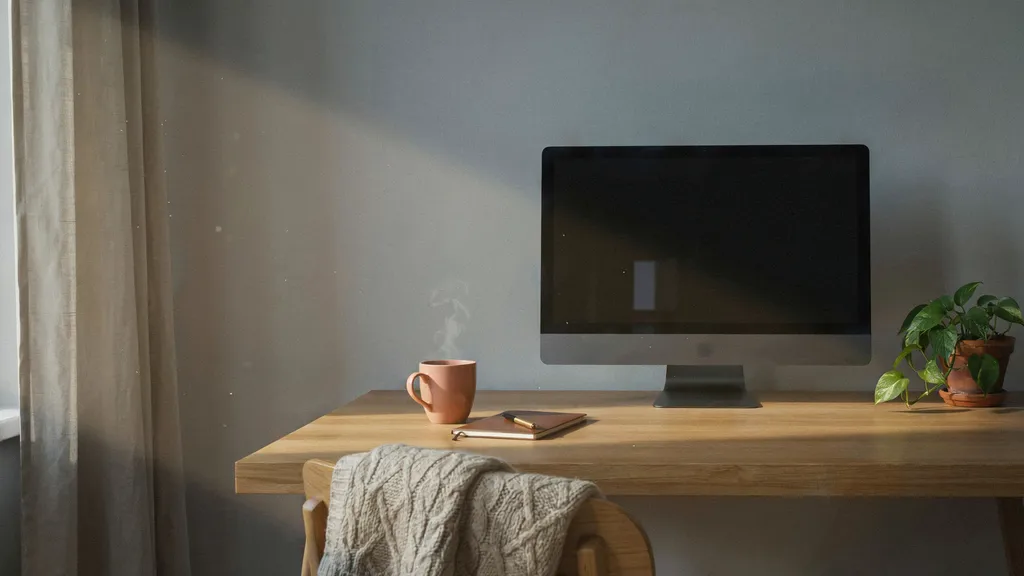
A stopping rule works better when it has an object attached. Fill it, and the walk to the kettle is the break you would otherwise skip.
5. Does the room decide whether you can put a game down?
More than anyone admits. A room that is dim, cluttered and lit only by the screen gives you no cue that the evening has moved on, so the session drifts. Three cheap changes fix it. Put a warm lamp on a timer somewhere in your sightline, so the light in the room changes even when the screen does not. Give the controller a specific home, because an object with a home gets put back and one without it stays in your hand. And leave one clear surface, so the desk at the end of the night looks finished rather than abandoned. If you want the longer version of this, see our guides to small gaming room ideas and building a gaming room aesthetic.

18x16 inches that gives everything on the desk one calm floor to sit on, and gives the controller somewhere obvious to land when you are done.
6. Why does competitive fatigue feel different from single-player fatigue?
Because they exhaust different things. Competitive play taxes your nervous system: every match is scored, other people are watching, and a bad run follows you into the next one. It produces a wired, slightly irritable tiredness, and the fix is a genre with no scoreboard, not a longer break from games. Single-player fatigue is duller. It usually means the loop stopped surprising you and you are completing a checklist for the sake of the ending. That one is cured by leaving the game unfinished, which is allowed. The practical rule: if you are tense, drop the ranked mode. If you are bored, drop the completion. Treating both with "play less" fixes neither.
7. What do you do when your main game stops being fun?
Stop playing it and say so out loud, even if only to yourself. The reason people stay in a game they no longer enjoy is rarely the game. It is the hundreds of hours already in it, the group who still logs on, and the vague sense that leaving wastes something. It does not. Those hours were already spent well. Then go smaller on purpose: a short game you can finish in an evening resets your sense of what playing is supposed to feel like faster than a 60-hour epic ever will. Come back in a month if you want to. Live-service games are designed to make you feel late. You are not late.

A progress bar you filled by choosing, not by grinding. The nice thing about a wall is that it never asks you to log in daily.
8. What does a calm gaming setup actually look like?
Quieter than the internet suggests. Fewer color-shifting lights, one warm lamp, and a surface where three or four things live instead of eleven. Screen at arm's length with its top edge at or just below eye level, so your neck is not doing overtime. Notifications off, because a session interrupted every four minutes never settles into the state you sat down for. One or two objects that are genuinely yours, chosen rather than defaulted into, because a space that looks like you is a space you can leave and come back to. A zen gamer setup is not a minimalist setup. It is an edited one.
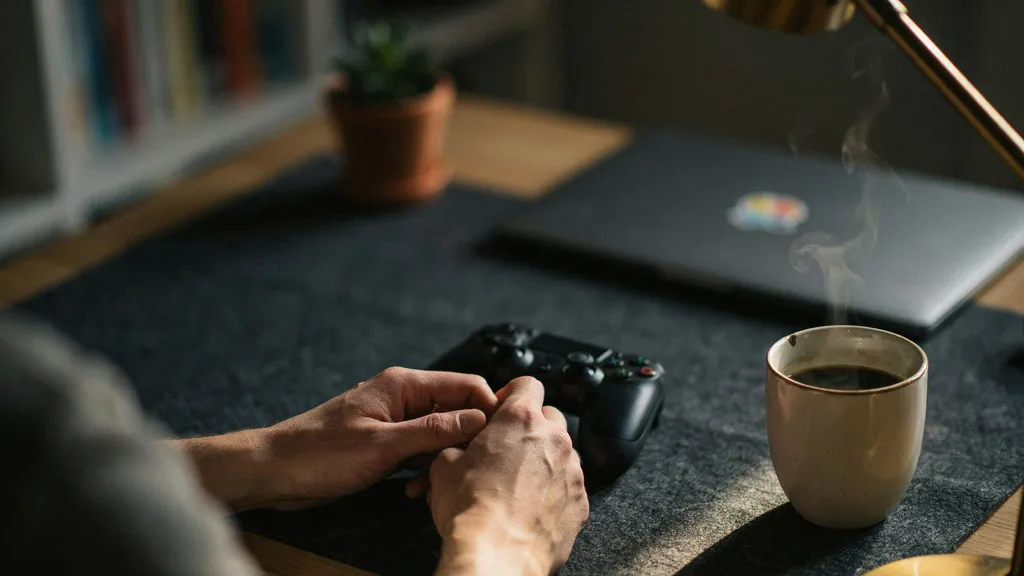

Two words for a way of playing that took you years to work out. Goes on the laptop lid, the console, the water bottle, the back of the monitor.
9. The real reason the hobby starts feeling heavy
It is not you, and it is not the games. It is a decade of design that decided your attention should be a metric: daily logins, seasonal passes, streaks that punish a night off, and a store page engineered to make a break feel like falling behind. Alongside it sits the wellness version of the same problem, mass-produced indifference in a calming font, telling everyone who loves this hobby to drink water and take breaks as though the fix were that shallow. Neither one knows what you play or why it matters to you. Mindful gaming is just you taking that decision back, one session at a time, in a space that looks like a person lives there.
Frequently asked questions
What are the symptoms of gaming burnout?
Usually a flat feeling before you start, sessions that feel like an obligation, and finishing tired without feeling rested. People describe scrolling their library without picking anything, losing interest in games they used to love. If it is only one game, that is a dip. If it has spread to your other hobbies, it is broader tiredness and worth treating as such.
How to recover from gaming burnout?
Take a real gap rather than a shorter session, around a week, and put something with a different shape in the slot: a walk, a book, cooking. Drop every obligation the hobby has accumulated, so no dailies, no seasons, no streaks. Come back with one short game you can finish in an evening. If the flatness reaches beyond gaming into work and sleep, look there too.
What is the 20 20 20 rule for gaming?
Every 20 minutes, look at something roughly 20 feet away for about 20 seconds. It is an eye-strain habit recommended by the American Optometric Association for anyone on screens. It will not fix gaming fatigue on its own, but it does take the edge off the sore, dry-eyed feeling that makes a long session end worse than it needed to.
Is 2 hours of gaming a day too much?
For most adults, no. Two hours is an evening hobby, roughly what watching a film costs. What matters far more is whether those hours are chosen, whether you can put the game down when you planned to, and whether the rest of your life still fits around them. Two focused hours with a clear ending beats four drifting ones for almost everyone.
Why do 90% of gamers never finish games?
Precise completion figures vary by game and are hard to pin down, but it is genuinely common for most players never to reach the credits. Modern games are long, backlogs are cheap, and interest naturally runs out before the content does. That is not a failure of discipline. Leaving a game unfinished when it stops being fun is one of the healthier habits in the hobby.
What are the 7 signs of burnout?
Commonly described signs include persistent tiredness, cynicism about things you used to enjoy, feeling ineffective, poor sleep, irritability, withdrawing from people, and a general flatness. In a hobby, that last one is the giveaway: nothing appeals, not just this game. If that flatness has lasted for weeks and reaches beyond gaming, a calm conversation with a doctor or counselor is a reasonable next step.
Play like it is yours, because it is.
Calm, deliberate pieces for the way you actually play. Made on demand, designed to sit together on one desk. Your Story, In Everyday Items.
Find Your Zen Gamer →Made on demand. If a piece does not feel like it speaks your language, we will make it right.
Build the calm version of your setup: browse the RaZits gaming stickers, the gaming mouse pads and desk mats, and the coffee mugs.

