

The highest-impact, lowest-cost upgrades for a small gaming room, in order, are these: fix the lighting, get everything off the floor, hang one large print instead of five small ones, then stop before the room feels full. In that order you can transform a room under 100 square feet for roughly $150 without buying furniture. A small room is not a compromised room. It is a room where every decision is visible, which is why cheap upgrades hit harder here than in a big space.
In this article
- 1. Turn off the ceiling light
- 2. Get everything off the floor
- 3. Hang one large print, not five small ones
- 4. Claim the wall above the desk
- 5. Paint one wall dark
- 6. Control the daylight
- 7. Cover the desk in one surface
- 8. Give the small objects a home
- 9. Borrow depth with one mirror
- 10. Leave one wall empty
- Frequently asked questions
1. Turn off the ceiling light and layer warm light instead
This is the cheapest change with the biggest return. A small room lit by one overhead fixture looks like a storage closet with a computer in it: flat light, screen glare, hard reflections on framed glass. Swap it for three low warm sources at 2700K to 3000K: a bias light behind the monitor, a desk lamp, and one lamp low in the far corner. Keep the color temperature identical across all three, because mixed whites are what make a room feel unresolved. The American Optometric Association suggests the same basics, lower-wattage bulbs and blinds to cut glare, plus the 20-20-20 habit. Skip room-wide color-shifting RGB: in a small space it reads as unfinished, not fun.
2. Get everything off the floor
Visible floor is the only thing telling your brain how big the space is, so every object on it costs you square footage twice. Route cables up the desk leg into one channel. Put the console on a shelf. Wall-mount the monitor or raise it on a riser so the surface underneath is usable again. If the desk can be wall-mounted, do it: clear floor beneath can make a 90 square foot room read closer to 110. None of this needs new furniture. It needs you to decide the floor is not storage.
3. Hang one large print instead of five small ones
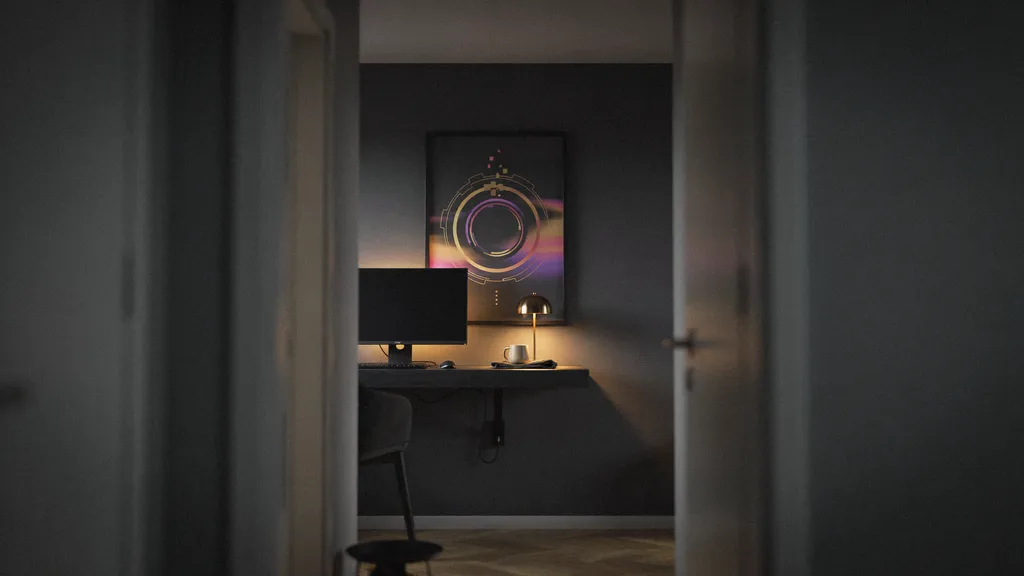
The instinct in a small room is to buy small art, and it is wrong. Several small pieces chop a wall into fragments and make the room feel busier, so smaller. One large piece gives your eye a single place to land, and the wall reads as one confident surface. For a standard desk that means an 18x24 inch print, spanning about two thirds of the desk width, hung with its center 57 to 60 inches up. It is the best square-foot-per-dollar decision in the room: a print costs what a new game does and changes everything.

One wall, one story. The piece your eye lands on the second you walk in, and the reason the room stops looking temporary.
| Where it hangs | Size to buy | Why |
|---|---|---|
| Standard small-room desk | 18x24 in | Spans about two thirds of the desk width and anchors the wall |
| Wide or dual-monitor desk | 24x36 in | Large enough to hold its own above a big surface |
| Cluster of three | One 18x24 plus two 11x14 in | A clear anchor with supporting prints, 2 to 3 in apart |
| Shelf, alcove or tight corner | 8x10 to 12x16 in | Fits without crowding the space around it |
| Above a sofa or daybed | 24x36 in | Hung 8 to 10 in above the back for balanced proportion |
4. Claim the wall above the desk
When the floor is gone the only direction left is up, and the wall between eye level and the ceiling is usually dead space. Two slim floating shelves, 24 to 36 inches wide and about 14 inches apart, take the things currently colonizing your desk. Keep them sparse: three or four objects each, with a taller item at either end to frame the middle. A small print leaning on a shelf reads as a collection rather than clutter, and small formats earn their place where a large piece would not fit.
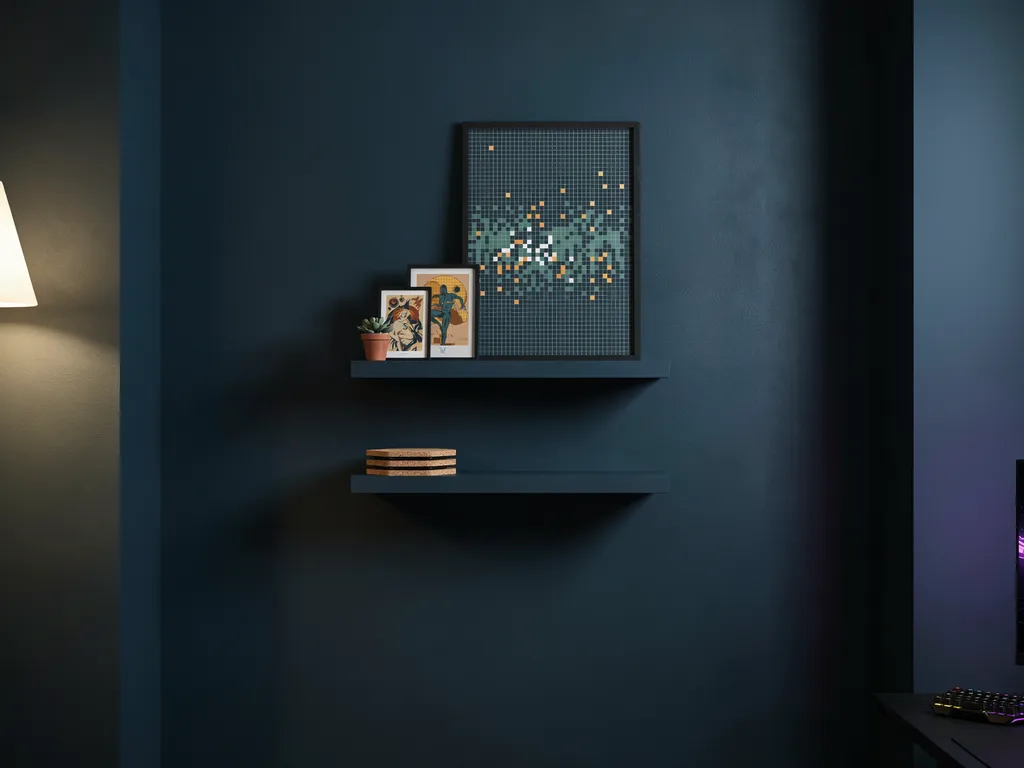

Small enough to live on a shelf or in an awkward alcove, and still say something. Every era you played, stacked like sediment.
5. Paint one wall dark, not the whole room
Everyone says paint a small room white so it feels bigger. In a gaming room that backfires: a bright wall beside a screen creates the exact contrast your eyes fight all evening. Paint only the wall your screen sits against, in deep charcoal, ink or forest, for under $45 a quart. A dark wall recedes, so the room reads deeper rather than smaller, your monitor stops floating in a bright void, and light-toned art hung there gains real presence. Renting? A dark fabric panel or one large dark-ground print does most of the same work.
6. Control the daylight before you touch anything else
A small room usually has one window and it is usually in the wrong place. Before spending on a monitor hood or anti-glare film, hang a blackout curtain or a cheap roller blind. It costs $25 to $40 and it is the difference between a room you can use at 2pm and one you only use after dark. Ideally the screen sits perpendicular to the window so light crosses the desk instead of hitting it. In a small room you may not get that choice, which is why the curtain matters more here.
7. Cover the desk in one continuous surface
A small desk holding six objects of different heights, colors and materials looks chaotic no matter how tidy it is. One large desk mat fixes that in a single move: it pulls everything on it into one composition and gives the setup a visual floor. Go as large as the desk allows, deep enough to sit under keyboard and mouse with room to spare. The pattern matters more in a small room, because it is a bigger share of what you see, and it is the one accessory visible in every session.
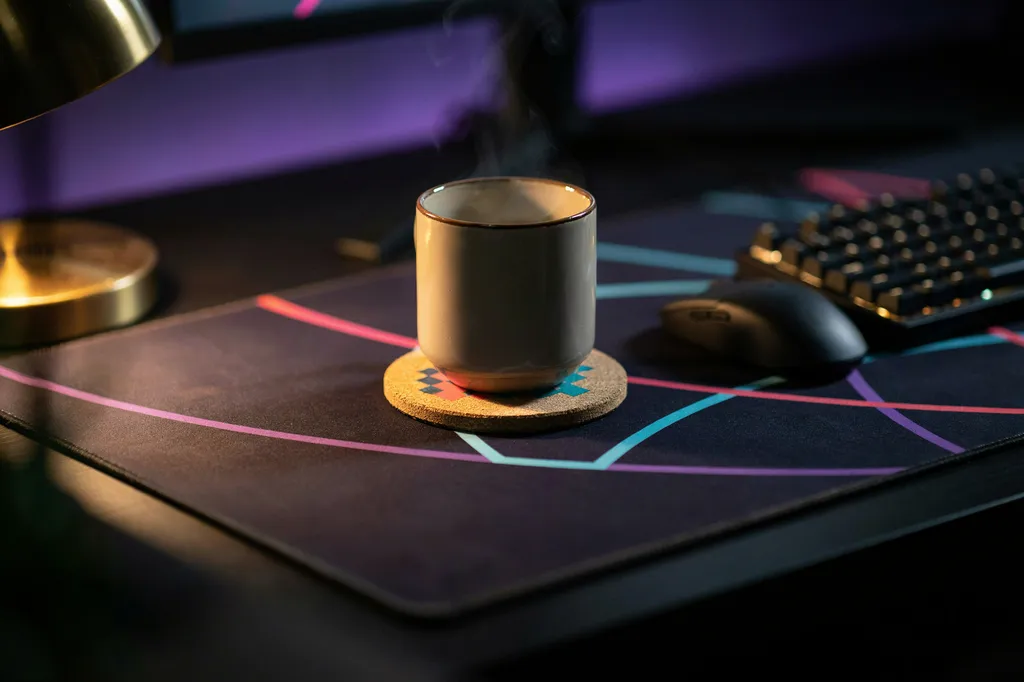

18x16 inches of warm arcade sunset under your hands. The small daily upgrade you actually notice, unlike the black rectangle it replaces.
8. Give the small objects a home
Small rooms are ruined by small things: the mug ring, the loose cable, the controller with nowhere to sit. In a big room they disappear. In a small one they are a third of the visual field. Three cheap things fix it for $20 to $35: a coaster or two so drinks have a spot, one shallow tray for whatever is loose, and a cable channel. It is the least glamorous item here and the one that keeps the other nine looking good six months from now.

Cork-backed, so the desk survives the long sessions. Pixel-era art, so the small stuff still sounds like you.
9. Borrow depth with one mirror
One mirror, or one piece of glass-fronted art, on the wall opposite your main light source visually extends a narrow room, because your eye reads the reflection as extra distance. A leaning mirror or a 20x30 inch wall mirror runs $20 to $60 secondhand. Two cautions: do not put it where it reflects your screen back at you, and stop at one. Two mirrors stop reading as depth and start reading as a fitting room.
10. Leave one wall empty on purpose
This is free, it is the hardest to do, and it separates a small room that feels calm from one that feels crammed. Pick one wall, usually the one behind you, and put nothing on it. Negative space is what gives the pieces you chose room to matter, and it is where your eyes rest between rounds. Three considered things and one clear wall reads as deliberate. The same room with nine reads as unfinished editing.
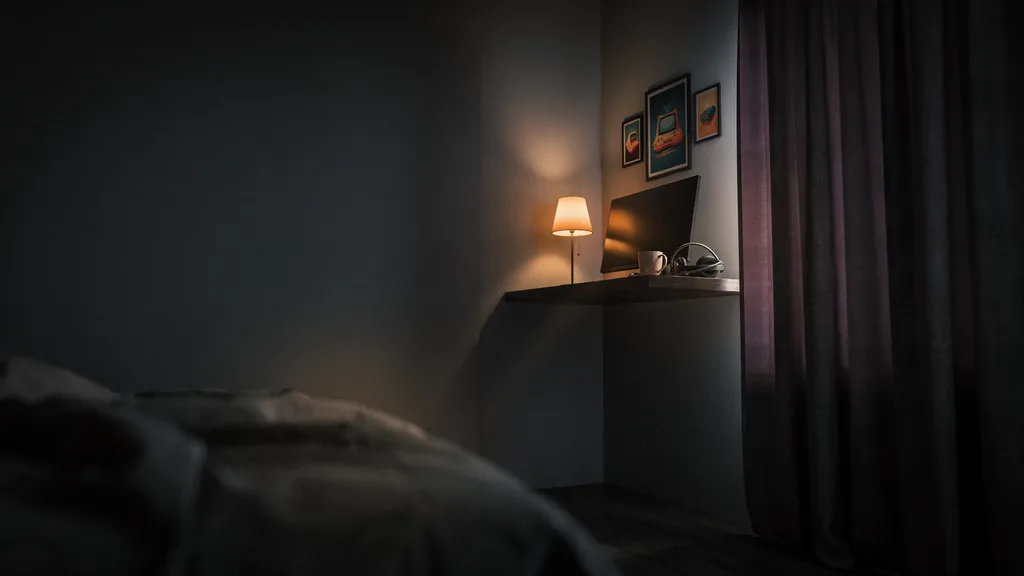
The real problem with most small gaming rooms
It is not the square footage. The internet sold every small room the same starter pack: the same color-shifting strip light, the same three mass-produced posters, the same black rectangle of a desk mat. Beige sameness in gaming clothing. Mass-produced indifference does not care what you played or who you played it with, and a small room exposes that faster because there is nowhere to hide. These upgrades are cheap because the expensive part was never the furniture. It was deciding what the room is about. More on choosing pieces that hold a wall: retro gaming room ideas and what to put on your gaming room walls.
Frequently asked questions
How do I make a gaming room in a small room?
Fix the lighting first with two or three warm low sources instead of an overhead fixture. Clear the floor by wall-mounting or shelving anything that does not need to be on it. Then hang one large anchor print with its center 57 to 60 inches up, and add shelves. Furniture comes last: under 100 square feet, what you remove matters more than what you add.
What should I put in a small game room?
A screen, a comfortable seat, warm layered lighting and one strong piece of wall art. After that, prioritize anything that gets objects off the floor and desk: two floating shelves, a large desk mat, coasters, a tray, one cable channel. Skip anything that eats floor space for a single purpose, like a beanbag or a second table.
How much does it cost to set up a small gaming room?
Excluding the PC or console and the chair, expect $100 to $250. A realistic split: $30 lighting, $25 to $50 shelves, $30 to $45 paint, $25 to $40 blackout curtain, $20 to $40 wall art, $35 desk mat. The lighting and floor-clearing steps deliver the most change for the least money.
What is the ideal size for a gaming room?
Around 100 to 150 square feet is comfortable for a single-player setup with a desk, chair and storage, or 200 plus if you want a sofa or second player. Below 80 square feet you can still build a good room, but you have to commit to wall-mounting, a single monitor and real restraint. Small rooms reward editing, not compromise.
Does dark paint make a small gaming room feel smaller?
Not on a single wall, and not behind a screen. A dark wall recedes visually, so one deep-toned accent wall behind the monitor makes the room read deeper rather than tighter, while cutting the bright-wall contrast that tires your eyes. All four walls dark in a room with one small window is where it closes in. Keep it to one wall and keep the lighting warm.
How many posters should I put in a small gaming room?
One large piece plus two smaller ones is plenty under 100 square feet, and one large piece alone is a finished look. The test is whether you can see clear wall around every frame. If frames nearly touch, or there is art on all four walls, take something down. Empty space is doing as much work as the art.
Small room. One wall. Your story on it.
The piece a friend spots from the doorway and immediately gets. Made on demand, designed to hang together. Your Story, In Everyday Items.
Find Your Art →Made on demand. If a piece does not feel like it speaks your language, we will make it right.
Small desk, big difference: browse the gaming desk mats, the gaming coasters, and the rest of the gaming room decor range.

