

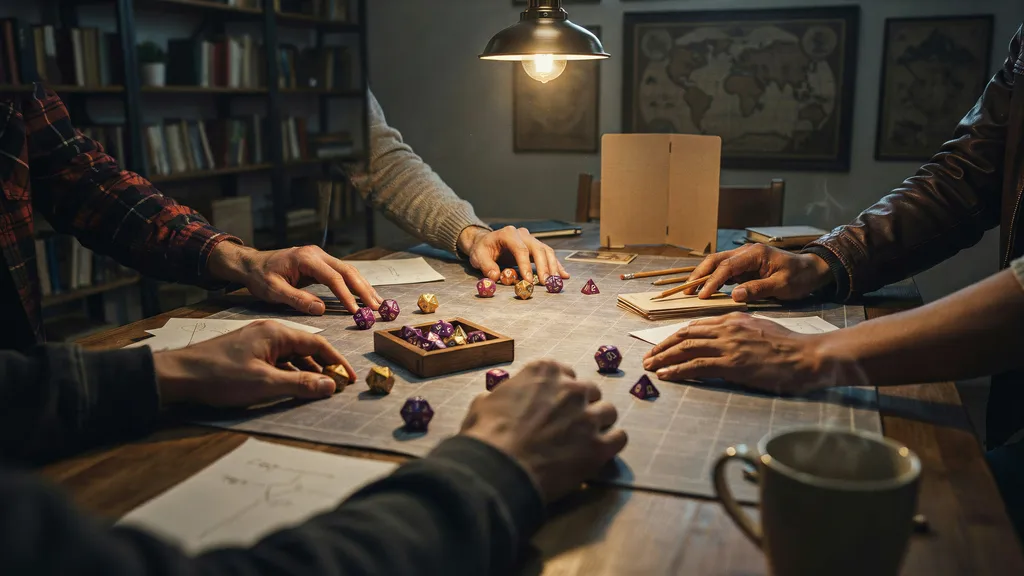
A tabletop RPG room is the only game room built for six people instead of one, and that single fact changes every decision in it. The table sits in the middle rather than against a wall, so wall art has to work from a seated position on four sides. Light has to land on a character sheet without washing out the room. The game master needs a wall the players cannot read, and the players need one worth staring at for five hours. Add a felt tray at each end so dice stay off the map, a surface three feet away for food, and chairs with real backs. Budget $250 to $600.
In this article
- 1. What makes this room different from a gaming setup?
- 2. How do you light a table so everyone can read a sheet?
- 3. Where does wall art go when the table is the center?
- 4. How do you give the GM a wall the players cannot see?
- 5. What size table do four to six people actually need?
- 6. Where do the dice live, and where do you roll them?
- 7. How do you keep snacks and drinks off the battle map?
- 8. Where do the campaign's own artifacts go?
- 9. What seating survives a five-hour session?
- 10. What does the whole room cost to decorate?
- The real problem with tabletop decor
- Frequently asked questions
1. What makes this room different from a gaming setup?
Every other gaming room is designed around one person facing one screen. This one is designed around a shared horizontal surface with four to six people around it, and almost nothing transfers. There is no monitor to anchor the layout, so the table becomes the anchor and needs clearance on every side for chairs to pull out. Sightlines run across the room instead of into a corner, which means anything on the walls is read from a seated height by five people at once. And the room has to survive a five-hour session, so comfort stops being a luxury and becomes the reason people come back next week.
2. How do you light a table so everyone can read a sheet?
With one warm source hung low over the center of the table, not with the ceiling light. A single pendant at 2700K to 3000K, hung 30 to 36 inches above the tabletop, drops a pool of light onto paper and the map while leaving the walls and corners dim, which is exactly the contrast you want. Overhead fixtures do the opposite: they flatten the mood and put glare on card sleeves and dice. Add one small clip lamp on a flexible arm at the game master's end for notes. Keep total output modest and kill glare where you can, which is the same principle behind the American Optometric Association's guidance on lighting and glare.
3. Where does wall art go when the table is the center?
On the wall the players face, centered on the table rather than centered on the wall. Seated eye level drops to roughly 44 to 48 inches, so the middle of a frame belongs at 52 to 58 inches instead of the standing gallery standard of 57 to 60. Pick the longest uninterrupted wall in the players' line of sight and treat it as one composition: one large piece centered, or a row of three at matching heights with 2 to 3 inches between frames. Everything else in the room can stay quiet. This is the wall that gets looked at for five hours, and it is the cheapest thing in here to get right.
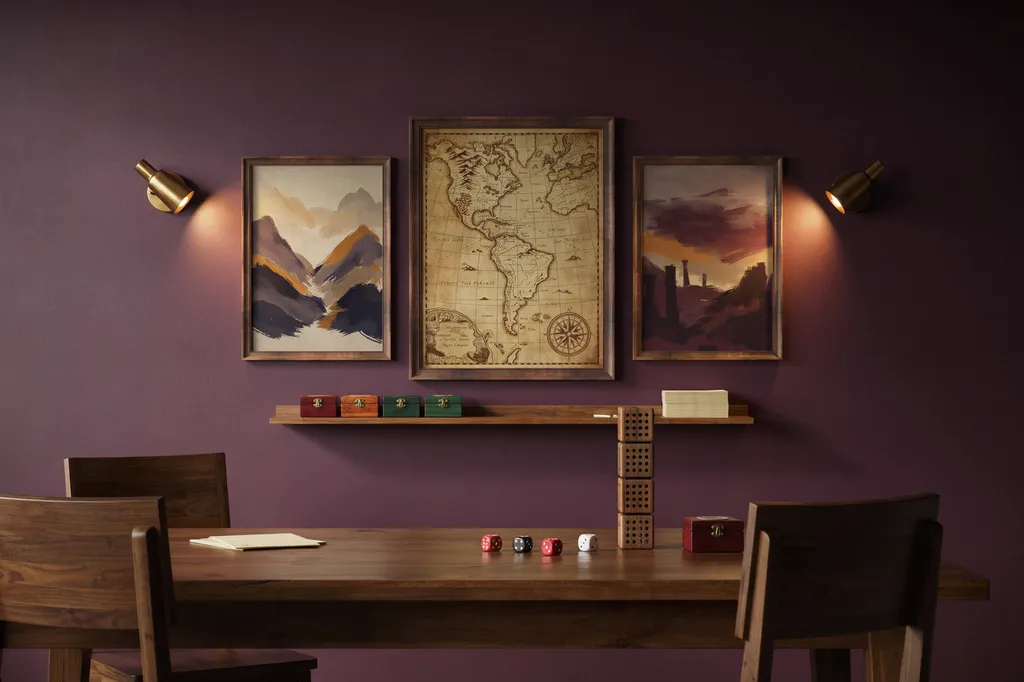

One clear centerpiece for the sightline every player holds all night. Matte paper, so the pendant above the table does not bounce off it.
4. How do you give the GM a wall the players cannot see?
Use the wall behind the players. The game master sits at one end of the table facing down its length, which means the wall behind the far seats is in their sightline all night and effectively invisible to everyone else. That is the place for the pieces that are for the game master alone: a reference print, a mood piece for the current arc, artwork that would give away a reveal if the party saw it. A slim shelf or a strip of cork at 60 inches lets it change between arcs without new nail holes. Every other room in the house has one audience. This one has two, looking in opposite directions.
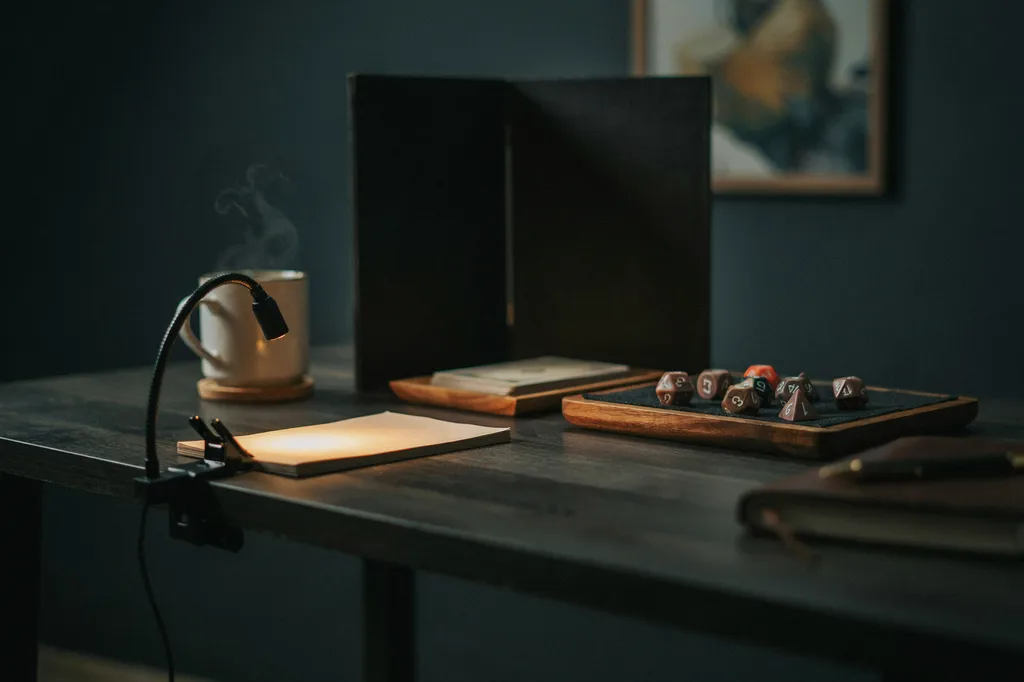

The one the party reads wrong on purpose. Goes on the wall only the game master looks at, which makes it a private joke instead of a poster.
5. What size table do four to six people actually need?
Twenty-four inches of edge per person, and a play area at least 36 inches deep so two people sitting opposite can both reach the middle. For six that lands on roughly 72 by 36 inches at a minimum, and 72 by 42 inches if the campaign uses a battle map and terrain. A 48 by 30 inch table seats four honestly and six badly. Height matters too: 29 to 30 inches is standard and works with normal dining chairs. Then leave 36 inches of clear floor on every side you want people to walk behind. That last number decides whether the room feels finished or crowded.
| Players | Table top | Room needed | What fits on it |
|---|---|---|---|
| 3 plus a GM | 48x30 in | 10x10 ft | Small map, sheets on laps or a side surface |
| 4 plus a GM | 60x36 in | 11x12 ft | Map, sheets at every seat, one dice tray |
| 5 plus a GM | 72x36 in | 12x14 ft | Map, sheets, two dice trays, the screen |
| 5 plus a GM, with terrain | 72x42 in | 12x15 ft | All of the above plus miniatures and terrain |
| Any number | 24 in of edge each | 36 in clear floor per walked side | The two numbers that stop a room feeling tight |
6. Where do the dice live, and where do you roll them?
In a tray, one at each end of the table. A felt-lined or leather-lined dice tray does three jobs at once: it contains the roll so a d20 never lands in someone's drink or scatters the miniatures, it drops the noise enough that people can keep talking through a roll, and it gives dice a fixed home so they are not living loose on the map between sessions. Storage is simpler than it looks: one small box or bag per person, on a shelf near the table rather than in a drawer across the room. Trays run $15 to $40, and two is the right number for six people.

Reads well in a dim room, which is the whole trick in here. Hang it over the shelf where the trays and boxes live so the storage wall stops looking like storage.
7. How do you keep snacks and drinks off the battle map?
Give food its own surface at least three feet from the table and make it the only legal place for anything greasy or open. A rolling cart, a sideboard or a small side table works; the point is that the rule gets enforced by geography rather than by asking people to be careful. Drinks are the harder problem, because they have to stay within reach. The workable compromise is a lidded bottle or a mug on a coaster, kept behind the dice tray line at each seat so nothing wet ever sits over paper. One spilled soda ruins a printed map, six character sheets and about forty minutes.

A handle beats a can, and a mug on a coaster behind the tray line is the compromise that keeps hot coffee at the table through a five-hour session.
8. Where do the campaign's own artifacts go?
On a dedicated strip of wall that is allowed to change, because a campaign generates objects. Handouts, the party's hand-drawn map of the region, a list of everything they have killed, a letter from a patron, the initiative order from a fight that went badly. None of it deserves a frame, and all of it is the most personal decor in the room. A four-foot cork strip, a length of picture rail with clips, or binder clips on a taut wire at 60 inches handles the whole job for under $40 and lets the room accumulate a record of the campaign instead of just its theme. Framed art says what you like. This wall says what you did.
9. What seating survives a five-hour session?
Dining chairs with real backs, not stools and not folding chairs. Five hours in a folding chair is the most common reason a group quietly stops meeting at your house, and it costs less to fix than anything else in the room. Look for a seat height of 17 to 19 inches against a 29 to 30 inch table, a back that reaches the shoulder blades, and a seat pan wide enough to shift position in. Mismatched secondhand wooden chairs are fine and often better than a matching set. Add one armchair off to the side for whoever is not in the current scene.
10. What does the whole room cost to decorate?
Between $250 and $600 if you already own a table, and you buy it in an order. Start with the pendant light at $40 to $120, because it changes the room more than anything else on the list. Then the player-facing wall at $60 to $150 for two or three framed pieces. Then $30 to $80 for two dice trays, about $40 for the artifact rail, and $30 to $60 for a cart. Seating is the wild card: free if you have chairs, $200 or more if you do not. The light and the wall are the two people notice on the first session.
The real problem with tabletop decor
The hobby gets sold to as a merchandise audience rather than a group of people who sit around a table for five hours a week. The result is a shelf of licensed rectangles that all say the same thing, priced as collectibles, designed to be recognized rather than lived with, and identical in ten thousand other rooms. That is mass-produced indifference in its tabletop form: decor that knows the genre exists but knows nothing about your table, your group, or the campaign you have been running since spring. A room that works is half considered choices and half accumulation, which is why the artifact rail matters as much as the frames. If the rest of the house is next, start with the gaming room ideas guide or what to put on gaming room walls.
Frequently asked questions
How do I decorate my gaming room?
Start with light, then the one wall people actually look at, then storage for the things you use every session. One warm source at 2700K to 3000K over the main surface, a centered piece or a row of three on the primary sightline at 52 to 58 inches, and a fixed home for every loose object. Skip anything that only looks good empty.
What are some essential game room decor items?
One warm pendant or lamp over the table, two or three framed pieces on the wall the group faces, a felt lined tray for dice, a rug to cut the echo, an off-table surface for food, and a changeable rail for handouts and maps. Six items, roughly $250 to $600, and all of them get used weekly.
What are popular gameroom themes?
Warm tavern, low-light study, arcade neon, retro pixel, minimal Scandinavian, and open shelving that treats the collection itself as the decor. For a table-centered room the low-light study and warm tavern directions work best, because both assume dim walls and one bright pool of light in the middle, which is what a long session needs.
What are popular game room trends right now?
Dimmable warm lighting instead of colored strips, tables that convert back to dining tables, dedicated wall rails so art can be swapped without new holes, and open shelving rather than closed cabinets. The wider move is away from rooms that photograph well and toward rooms designed for five hours of actual play.
What size table fits 6 people?
About 72 inches long by 36 to 42 inches wide, working from roughly 24 inches of table edge per person. That is the standard six-seater footprint. For a game with a battle map, terrain and paper at every seat, take the wider end of that range, and leave 36 inches of clear floor behind each side people walk past.
What size should a board game table be?
At least 36 inches deep so two people sitting opposite can both reach the center, and 24 inches of edge per player for the width. A height of 29 to 30 inches matches normal dining chairs. Six players want roughly 72 by 42 inches, and four are comfortable at 60 by 36 inches.
Six people. Five hours. One room.
Art for the wall they all face, and for the one only you can see. Made on demand, designed to hang together. Your Story, In Everyday Items.
Shop Gaming Posters →Made on demand. If a piece does not feel like it speaks your language, we will make it right.
Build the room: browse the gaming posters and the rest of the gaming room decor range.

