

Couch co op games put two to four people on one sofa, in front of one screen, playing the same game at the same time. What people miss is not the games. It is the nine specific situations the format created: the screen-peeking accusation, the second controller that was visibly worse, the sibling who reached for the power switch, the pad handed over after a death, the friend who was only ever good at one character. Online play has better graphics, better matchmaking and better opponents. It cannot reproduce a single one of those, because all of them needed a room. Here are the nine, and why they belong on a wall.
In this article
- 1. The screen peek, and the accusation that followed
- 2. Player two and the visibly worse controller
- 3. The sibling who unplugged the console to win
- 4. Handing the pad over after you died
- 5. The friend who was only good at one character
- 6. The house rules nobody ever wrote down
- 7. The person who never played and never left
- 8. "Pause it" and the pause that never came
- 9. One more game before you have to go home
- What did couch co-op have that online play cannot copy?
- The real problem with gaming nostalgia
- Frequently asked questions
1. The screen peek, and the accusation that followed
Split-screen created the only form of cheating that could be committed by moving your eyes. In the split-screen shooter, everyone's position was printed on the television in front of everyone, so the game became a contest of self-control: could you play your half while somebody's map sat six inches away, fully visible and undeniably useful. Nobody could. The accusation was never really about fairness, either. It was an excuse to look at each other. Online play solved screen peeking completely, which is another way of saying it removed the last reason anyone had to turn their head.
2. Player two and the visibly worse controller
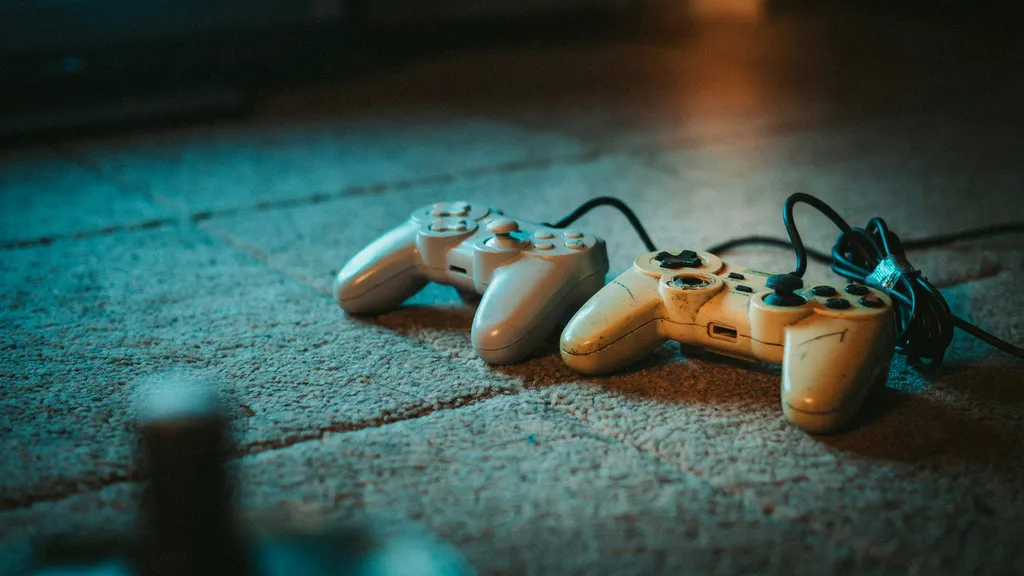
Every house had a good controller and a lesser one, and the ranking was never in dispute. The good pad had tight sticks and an unbent cable. The other one was yellowed, had a mushy shoulder button, and was held together at the strain relief with a wrap of tape. Whoever owned the console got the good one. Whoever visited got the other, and got told it was fine. That small unfairness taught more about hospitality and grudge-holding than school did, and everyone reading this knows which of the two pads they usually held.
3. The sibling who unplugged the console to win
The nuclear option. Losing badly enough, with no path back, a younger sibling would stop playing the game and start playing the room: a foot on the power cable, a hand behind the console, a look of total innocence and a screen full of nothing. Two hours of progress, gone, and no save file. It was outrageous, and also the most honest move in the format, because it admitted out loud that the console lived in a house and the house had politics. Nothing online has ever matched it. Rage quitting is a menu option now, and it costs nobody anything.

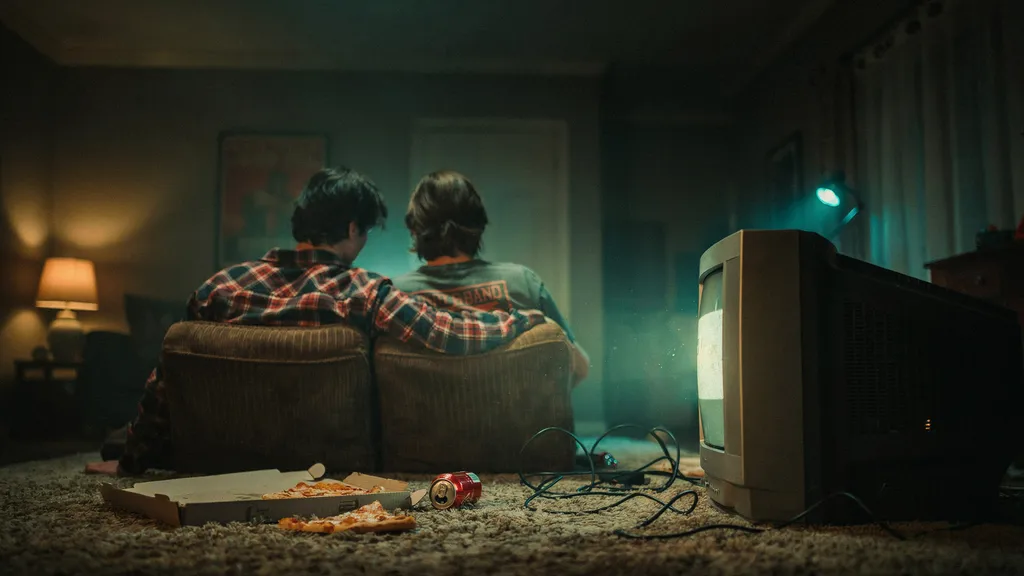
The format itself, on the wall: one screen divided, two people who had to sit next to each other for the whole match. Enhanced matte paper, sized from 18 by 24 inches up.
4. Handing the pad over after you died
Before drop-in play, a lot of games were technically single player and socially cooperative: one life each, and when you lost yours, you physically passed the controller to the person beside you and became an audience. That handover was the small ceremony at the center of the whole era. You had to watch someone else reach the part you could not, in silence, with your hands empty. Then you got it back, warmer than you left it. Losing had a room in it. Now you close a window, and nobody sees your face while you do it.
5. The friend who was only good at one character
Every group had a specialist. One friend had ground a single fighter in the two-player fighting game into muscle memory, knew four moves in total, and would beat all of you with those four moves for the rest of the decade. Give them anyone else and they were the worst player in the room. So a house rule arrived: they were not allowed that character on their birthday, or after nine o'clock, or ever again, depending on how the last match went. That is not a skill ceiling. That is a personality, and everyone in that room could name it.

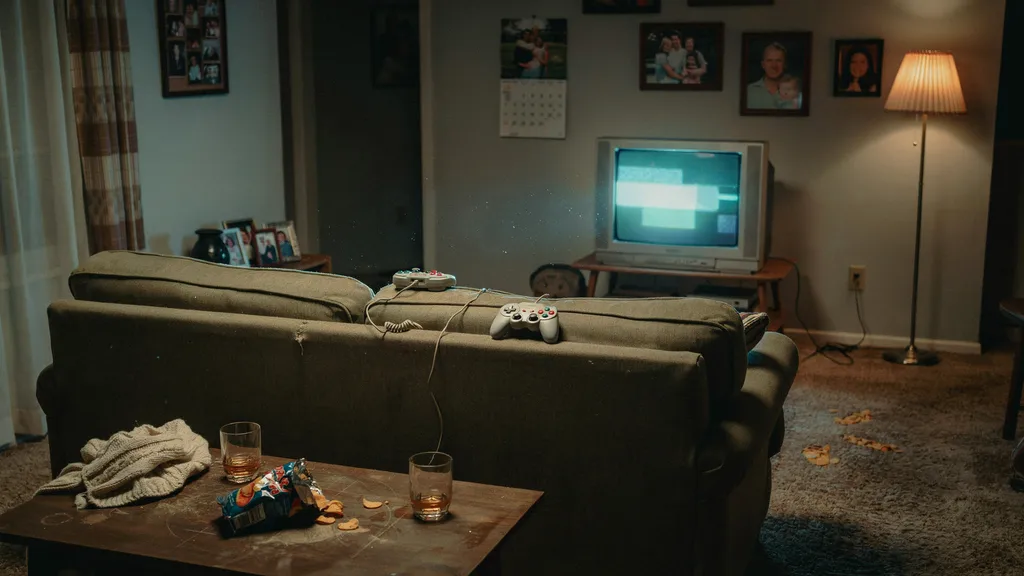
Two separate worlds running on one screen, three feet apart. If you want a print that explains the whole format without a word of explanation, it is this one.
6. The house rules nobody ever wrote down
Each house ran a private rulebook that existed only in speech. No blue items on the last lap of the kart racer. No throws in the brawler. Winner stays on, but only for three, then the pad goes round. Whoever owns the console picks the track. These rules were enforced with total confidence and never once recorded, so they varied street by street and were non-negotiable inside any given living room. That is folk law, invented by children, about a machine. Online play replaced all of it with a settings menu, and settings menus have never started a single argument worth remembering.
7. The person who never played and never left
There was always a fourth person on the arm of the sofa who did not want a turn. They commentated. They warned you about the thing behind you, incorrectly. They had strong opinions about your driving line and no intention of ever proving them. In a two-controller house they were not a spare player, they were the crowd, and the crowd is much of why it mattered. Playing well is different when somebody is watching for free. Streaming rebuilt the audience but put it behind glass, which is not the same room.
8. "Pause it" and the pause that never came
Somebody's mother called from the kitchen, or the phone rang, or a dog got out, and one player shouted the two words that only worked in this format: pause it. Then the other player did not, because they were winning. Local multiplayer games had a pause button that belonged to whoever reached it first, which made it the most political button on the pad. Online, nothing waits for you. The match continues without your permission, and it has no interest in what is happening in your kitchen.
9. One more game before you have to go home
The best part of couch co-op was also the part that ended it: a hard stop. Somebody had to be home before dark, or a parent was already in the doorway with car keys, and so you played one more round with all of the intensity that a real deadline creates. Then it was over, and the room went quiet, and it stayed a specific evening rather than a session log. Online multiplayer has no closing time. That is a feature, and it is also the reason almost nobody can name a particular night of it.
What did couch co-op have that online play cannot copy?
Four things, and none of them are technical: the roster was chosen for you, the information was shared, losing happened in front of witnesses, and the memory outlived the hardware. Online play is better at almost everything else. It has more players, higher frame rates, fairer matchmaking and no arguments about who held the good pad. What it does not have is a room, and every one of the nine memories above needed a room to happen in. Couch co op nostalgia is not really about the games. It is about the only format that made other people unavoidable.
The same nine as a working reference, with what was underneath each one.
| The memory | What was actually happening | Why it works on a wall |
|---|---|---|
| The screen peek | Shared information, zero privacy | A divided screen is instantly readable as a symbol |
| The worse controller | Household hierarchy, made physical | Two pads, one nicer, is a whole story in one image |
| The unplugged console | Losing had consequences in the room | Everyone with a sibling recognizes it in one second |
| The handover | Turn taking as a small ceremony | The gesture reads even to people who never played |
| The one-character specialist | Personality beating practice | A running joke that a group still shares |
| The house rules | Unwritten local law about a machine | Print one rule and everyone knows whose house |
| The watcher | A free audience, in the room | Explains why the wins felt like they counted |
| The pause that never came | One button, contested by two people | The most quotable two words of the era |
| One more before home | A hard stop that made it an event | Gives the whole thing an ending, which art needs |

The same comparison as the chart above, made to hang. Good above a couch that still has two controllers on it, or in a hallway where guests will ask about it.
The real problem with gaming nostalgia
Most of it is sold to you as a decade rather than as your own evening. A store prints a generic pixel grid, slaps a font from a catalog on it, and sells the same rectangle to four hundred thousand people who each had a completely different living room. That is mass-produced indifference in its nostalgia form: gear that references the era without knowing anything about the era you had. The nine moments above are specific, which is the whole point. Put the one that is actually yours on the wall, near the couch, where somebody will recognize it and immediately start arguing about a controller. If the whole room is the project, start with the gaming room ideas guide or the retro gaming room ideas walkthrough.
Frequently asked questions
What are couch co-op games?
Couch co op games are games two or more people play together in the same room, on one screen and one machine, either split-screen or sharing a single view. The defining feature is not the genre, it is proximity. Everyone can see everyone, nobody can be muted, and the argument about who cheated happens face to face.
What is a 2 player co-op game?
A two player co-op game is one where both players work toward the same goal instead of against each other. It covers shared-screen puzzle games, side-scrolling brawlers, farming and building games, and campaign shooters. The test is simple: if you both lose when one of you fails, it is co-op rather than competitive.
What are some good 2 player couch co-op games?
The formats that hold up best for two people on one couch are cooperative kitchen and chore games, side-scrolling brawlers, shared-screen puzzle platformers, farming and life simulators, and campaign shooters with a split-screen option. Choose by tolerance for chaos: a brawler suits a loud evening, a farming game suits a quiet one.
What games have co-op split-screen?
Split-screen co-op survives mainly in four genres: kart and driving games, campaign shooters, sports titles, and party or minigame collections. Farming, building and puzzle games usually use one shared screen instead of a split. Filtering your storefront for local or shared-screen co-op is the fastest way to see what your own platform still supports.
What is the best couples couch co-op game?
For couples, the best couch co-op game is usually cooperative rather than competitive, and forgiving about skill gaps. Cooking, building, farming and puzzle-platform formats work because the difficulty comes from coordination rather than reflexes. Anything with a scoreboard between the two of you tends to end the evening earlier than either of you planned.
What are good splitscreen games?
A good split screen game earns its half of the screen. It keeps the important information large enough to read at half height, lets a second player drop in without restarting, and stays fun when one player is clearly better than the other. Those three qualities matter far more than the genre or the release year.
One screen. Two people. Worth a frame.
Prints for the format that made other people unavoidable. Made on demand, printed when you order. Your Story, In Everyday Items.
Shop Gaming Posters →Made on demand. If a piece does not feel like it speaks your language, we will make it right.
Keep going: browse the gaming posters and the rest of the gaming room decor range.

