

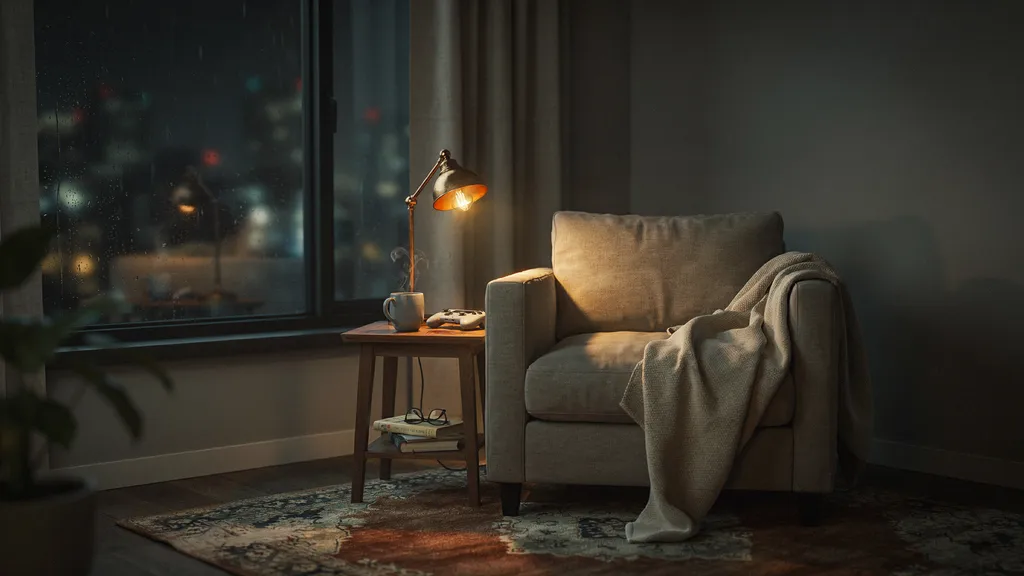
A cozy gaming setup is built from six physical decisions, and the first one carries the rest: every bulb in the room between 2200K and 3000K, with the ceiling light switched off. After that comes textile, seating you can sit in for three slow hours, quiet room noise, one scent or one warm drink, and warm-toned art instead of neon. The whole stack runs about $115 to $470 depending on what you already own, and no part of it needs new hardware. Cozy is not a color palette you photograph. It is a set of specifications, plus a slower pace of playing.
In this article
- 1. What actually makes a gaming setup cozy?
- 2. What color temperature should the lights be?
- 3. Why does cool white light kill the effect?
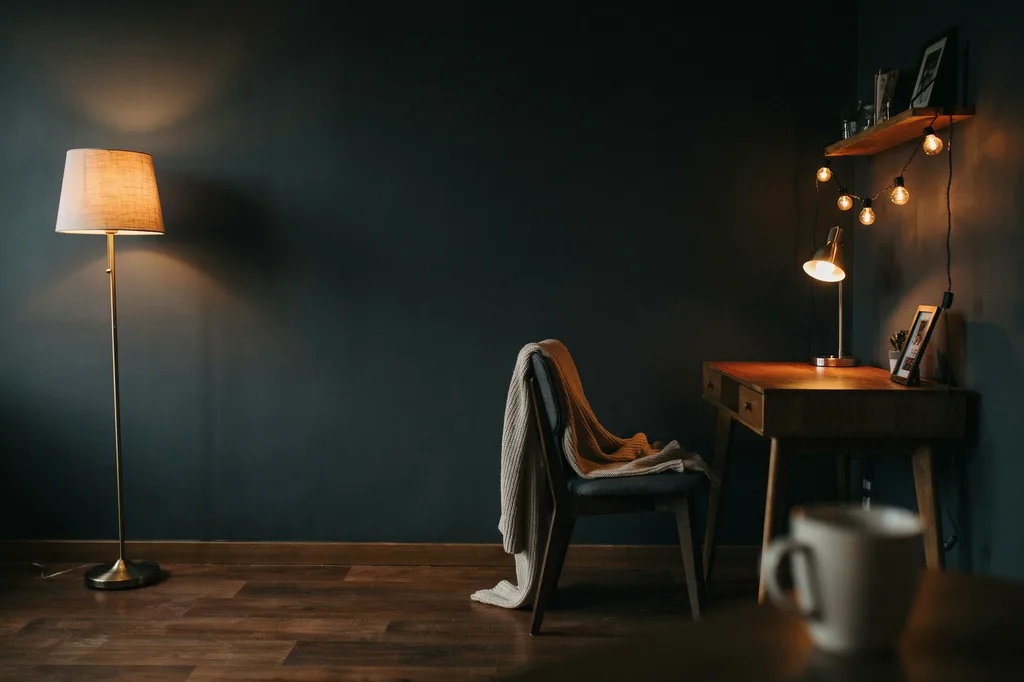
- 4. How do you layer light at three heights?
- 5. What do blankets and rugs do to a room?
- 6. What seating works for a three-hour session?
- 7. Warm-toned art or neon signs?
- 8. What about sound and scent?
- 9. Where is the line between cozy and cluttered?
- 10. Is cozy the room, or the pace of the session?
- The real problem with cozy gaming content
- Frequently asked questions
1. What actually makes a gaming setup cozy?
Six layers, in this order: light temperature, textile, seating, room sound, scent or a warm drink, and warm-toned art. The order matters because the layers are not equal. Get the light wrong and a $52 blanket, a rug and three prints will still read as a cold room with soft things in it. Get the light right and a folded blanket on a chair arm finishes the job on its own. Every layer below is cheap, reversible and physical. Not one of them requires a different monitor, a different chair or a different room.
2. What color temperature should the lights be?
Between 2200K and 3000K, and nothing in the room above 3500K. Kelvin is printed on every bulb box, usually smaller than the wattage. At 2700K you get the light of an old filament bulb, amber enough to make wood, fabric and skin look warm. At 2200K you are into candle territory, which is beautiful for a corner lamp and too dim to be your only source. At 4000K a room reads as an office, and at 5000K it reads as a garage. The number is the whole decision, and it costs $10 to $40 to fix.
| Color temperature | What it looks like | Use it for | Cozy? |
|---|---|---|---|
| 1800K to 2200K | Candle, dying fire | Corner floor lamp, shelf string lights | Yes, as an accent only |
| 2700K | Old filament bulb, amber | Your main lamp. The default answer | Yes, best all-round |
| 3000K | Warm white, slightly cleaner | Desk lamp if you also read or draw | Yes, the upper limit |
| 4000K | Neutral white, flat | Kitchens and offices | No |
| 5000K to 6500K | Daylight, blue-tinted | Garages and work benches | No, this is the mistake |
3. Why does cool white light kill the effect?
Because cool light flattens texture and cancels every warm color in the room. A knit blanket lit at 5000K loses the shadow between its stitches and reads as a flat gray shape, so the softest object in the room stops looking soft. Warm wood turns yellow-gray. Rust and oatmeal tones go muddy. Cool overhead light also arrives from above, which kills the long low shadows that make a room feel small and enclosed. Add a bright screen to a cool bright room and you get glare instead of contrast, which is exactly the tiring combination to avoid.
4. How do you layer light at three heights?
One source near the floor, one at desk or table height, one at shelf or eye height, all warm, and the ceiling fixture off. Floor level is a corner lamp or a small uplight, and it does most of the mood work. Desk level lands light on your hands, the mug and the controller. Shelf level, usually a string of warm bulbs or a picture light, keeps the upper half of the room from going black. Three small sources beat one bright one every time, and the American Optometric Association makes the same point about softer ambient light and the 20-20-20 habit for long screen sessions.
5. What do blankets and rugs do to a room?
Two measurable things. They absorb high-frequency reflections, so speech and game audio stop ringing off bare walls and hard floors, and the room sounds closer without you touching a volume slider. They also scatter light instead of bouncing it, which is why a room with three soft surfaces feels warmer at the same brightness than the same room with none. Three surfaces is the practical threshold: one blanket, one rug of about 5 by 7 feet, and one curtain or fabric wall hanging. That is the cheapest acoustic and visual upgrade a gaming room can get.

A gaming throw blanket that earns its place twice: over your legs during a slow session, over the chair arm the rest of the week. Pixel era artwork, warm palette, no neon.
6. What seating works for a three-hour session?
Something you can recline past 100 degrees in, with your feet flat and the screen 20 to 28 inches from your eyes. That is a different requirement from competitive seating, which wants you upright at about 90 degrees, forward on the seat and locked in place for reaction speed. Slow sessions want the opposite: weight off your lower back, knees supported, and no armrest jabbing your elbow when you shift. A $25 footrest and a cushion behind the lumbar curve change more than a $300 chair does, and a blanket over your legs does the rest.

Ember and rust tones, which is the palette that reads warmest under a 2700K bulb. In 30x40 inches for a chair or 50x60 inches for a couch.
7. Warm-toned art or neon signs?
Warm-toned art, if cozy is the goal. Neon and RGB signs emit their own light, usually in saturated cyan, magenta or blue, and that light lands on your walls and cancels the 2700K you just bought. Printed art reflects whatever light you give it, so it joins your palette instead of fighting it. Practical spec: two or three prints at 18 by 24 inches, hung with the bottom edge 57 to 60 inches from the floor so they sit at seated eye level rather than standing eye level. Keep the palette in rust, amber, cream and deep green.

Hand-drawn cartography on warm parchment, in the 18x24 inch size this section recommends. Matte paper, so lamplight lands on it softly instead of bouncing back.
8. What about sound and scent?
Both are free or close to it, and both are usually skipped. For sound, deal with the room before the game: a fan you can hear at idle, a buzzing power supply or a rattling vent will undo every soft surface you added. Then add low ambient audio, rain or a quiet loop, at roughly 30 percent of your game volume. For scent, one source only. A single candle or a full mug of something hot beats a diffuser plus a candle plus an air freshener, which just reads as a busy room in a different sense.

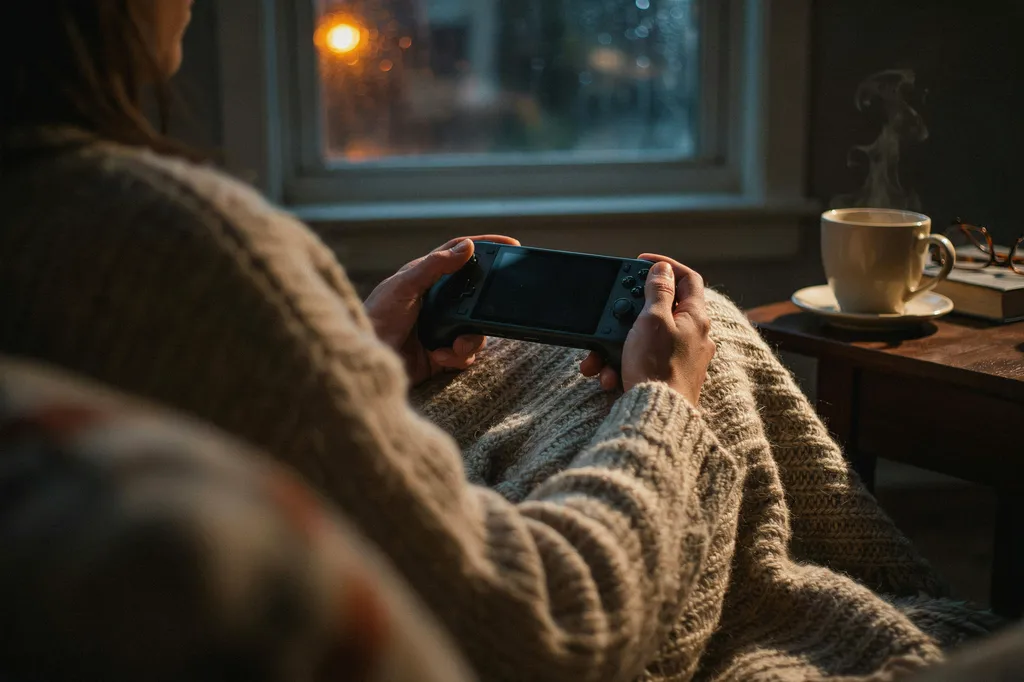
A full mug is the cheapest session timer there is: when it is empty, you have been sitting long enough to stand up. Ceramic holds heat far longer than a travel lid.
9. Where is the line between cozy and cluttered?
Cozy objects have a home and a job. Cluttered objects have neither. That is the whole distinction, and it is why two rooms with the same number of things read completely differently. A blanket folded on a chair arm is cozy because it lives there and you use it. The same blanket in a heap on the floor is clutter. Practical test: pick up every soft or decorative object in the room and ask where it goes when you are not using it. Anything without an answer is the thing making the room feel busy rather than warm.
10. Is cozy the room, or the pace of the session?
Both, and the honest answer is that pace matters more. You can build every layer above and still feel wound up at midnight, because a room cannot slow down a session you are playing at speed. The room is permission, not the effect itself. What actually makes a session feel cozy is a stopping point you decided on before you started, a game that does not punish you for pausing, and a genuine gap between sitting down and the next thing you have to do. If the sessions themselves are the part that feels rough, the room is not the fix. Start with mindful gaming instead.
The real problem with cozy gaming content
Almost all of it is a mood board. Search the phrase and you get thousands of photographs of somebody else's corner, tagged with a palette and zero numbers, so you scroll for an hour and learn nothing you can act on. That is mass-produced indifference in aesthetic form: the look sold back to you as a feeling, with the specifications stripped out because specifications are harder to photograph. Cozy is a Kelvin value, three soft surfaces, a recline angle and a stopping time. Once you know that, the decor becomes the fun part rather than the whole project. If you want the wider room view, the gaming room aesthetic guide compares cozy against neon and minimal, and small gaming room ideas covers doing all of this in a tight space.
Frequently asked questions
How to make your gaming setup more cozy?
Change the bulbs to 2700K and turn the ceiling light off. That single step does more than everything else combined. Then add three soft surfaces, a blanket, a rug and a curtain, put one warm light at floor level and one at desk level, and hang two warm-toned prints at seated eye level.
What makes a video game cozy?
Low stakes and no clock. Cozy games are usually built around tending, gathering, building or helping rather than beating something, they let you set your own pace, and they do not punish you for stopping mid-task. Farming, life simulation, decorating and gentle puzzle games are the genres that fit most reliably.
What does cozy gamer mean?
Someone who plays for comfort rather than competition, and who treats the space around the screen as part of the hobby. In practice it describes both a taste in games, slow and low-pressure ones, and a taste in rooms: warm light, soft textiles, a mug within reach, and no interest in a leaderboard.
How much is a nice gaming setup?
For the cozy layers specifically, about $115 to $470 on top of hardware you already own: $10 to $40 on warm bulbs, $50 to $150 on a blanket and a rug, up to $250 on seating fixes, $15 to $30 on a mug or candle, and $40 to $70 on two or three prints.
How to make your gaming setup comfortable?
Set the screen 20 to 28 inches from your eyes with the top of it at or just below eye level, recline past 100 degrees, and get your feet flat on the floor or on a footrest. Then cut the contrast between a bright screen and a dark room with one warm lamp beside you.
What is the psychology behind cozy games?
They give you back control of the pace. Most of the day runs on other people's deadlines, and a game with no timer, no failure state and small visible progress is a rare place where you decide what happens next and how fast. That is why the room matters too: it signals the same permission to slow down.
Warm light. Soft blanket. No clock.
The layers that make a session slow, in a palette that works at 2700K. Made on demand, designed to sit together in one room. Your Story, In Everyday Items.
Shop Gamer Throw Blankets →Made on demand. If a piece does not feel like it speaks your language, we will make it right.
Build the stack: browse the gamer throw blankets, the warm-toned gaming posters, and the mugs.

