

The best reading nook ideas all do the same one thing: they make a corner feel like a different place from the room it sits in. That is the whole trick, and it comes down to four cues your body reads before your brain does. Enclosure on three sides. Something happening overhead. A change underfoot. Its own light. Get those four and a nine square foot corner becomes a portal. Miss them and you have an expensive chair parked against a wall. Below are the actual numbers behind each cue: seat depth, back angle, light height, surface reach, and where the one piece of art goes.
In this article
- 1. What makes a corner feel like a portal?
- 2. What seat depth and back angle do you need?
- 3. How do you light a reading nook without eye strain?
- 4. Where does the surface go, and how big?
- 5. How do you build a nook with no alcove?
- 6. How small can a small reading nook be?
- 7. What do you do about sound?
- 8. What goes on the one wall you can see?
- 9. What does a reading nook cost to build?
- The real problem with reading nook inspiration
- Frequently asked questions
1. What makes a corner feel like a portal?
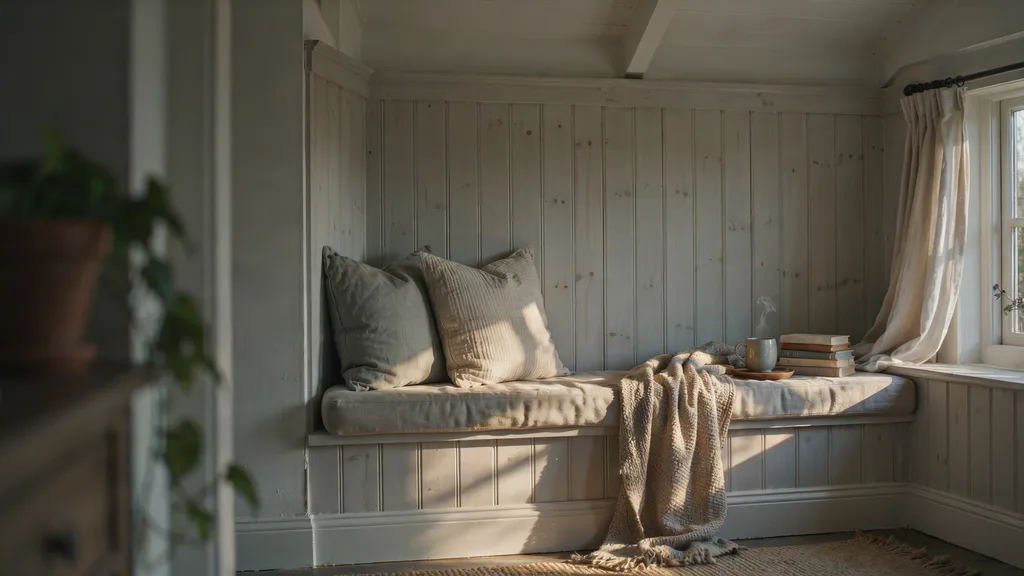
Enclosure, a ceiling cue, a floor change, and its own light. Enclosure means something solid on three sides of you, so nothing can approach from behind. A ceiling cue means the space above your head is lower or different: a canopy, a low pendant, a shelf, even a band of darker paint. A floor change means a rug, a step, or a different surface, so your feet register a threshold. Its own light means one warm lamp inside the nook, never the room's overhead fixture. Every mood board on the internet shows you the cushions. The cushions are not what makes it feel like somewhere else.
2. What seat depth and back angle do you need?
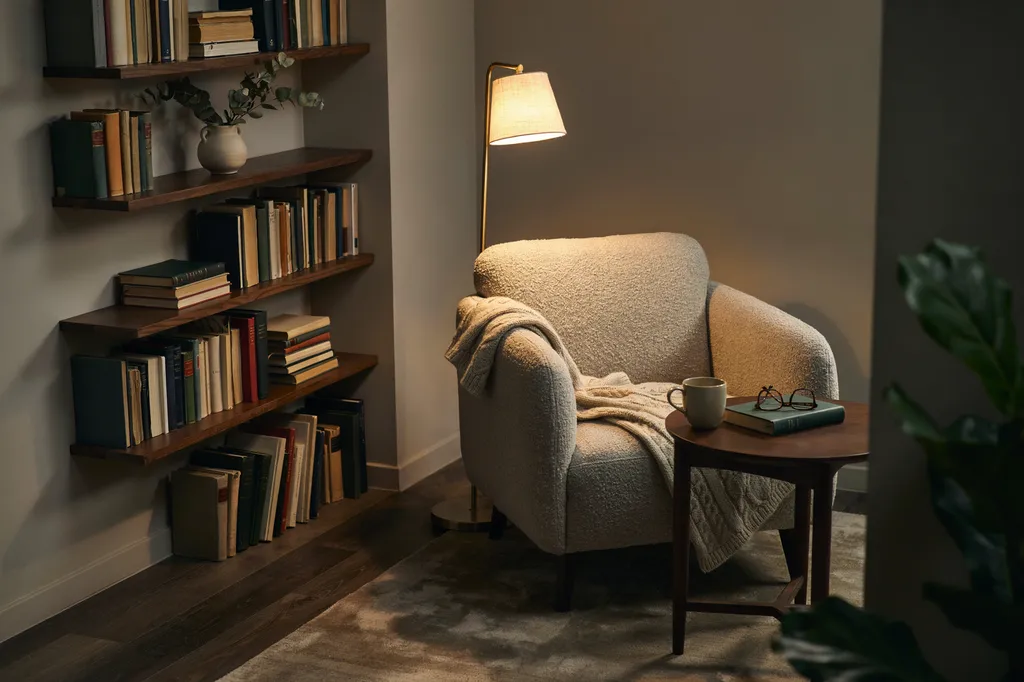
Reading and lounging want different chairs, and this is where most nooks go wrong. Reading wants a seat depth of 18 to 20 inches and a back reclined to roughly 105 to 110 degrees, so your head stays upright enough to look down at a page without your neck holding itself up. Lounging wants 22 to 24 inches of depth and 115 degrees or more, which feels wonderful for ten minutes and puts you to sleep by page four. Seat height of 16 to 18 inches lets most adults plant both feet. If a chair is too deep, a firm lumbar pillow behind you fixes it for about $45.

A 22 inch pillow behind your back cuts an over-deep seat down to reading depth and does the decorative work at the same time. Two jobs, one object.
3. How do you light a reading nook without eye strain?
One warm lamp, positioned beside you and slightly behind your shoulder, with the bottom of the shade landing about 48 to 54 inches off the floor. That puts light on the page and keeps the bulb out of your field of view. In front of you it glares off paper and shines into your eyes. Behind you dead center and your own head casts the shadow. For color, 2700K to 3000K reads as warm and evening-appropriate; 4000K and up feels like an office. As a practical target, an 800 to 1100 lumen bulb, roughly a 60 to 75 watt incandescent equivalent, is plenty for one chair. The American Optometric Association makes the same point about glare from overhead lighting and windows, and it applies to paper too.
4. Where does the surface go, and how big?
Within 16 inches of your hand, 22 to 24 inches off the floor, and at least 12 inches across. A nook without a surface is not a nook, it is a chair, because sooner or later you have to put the mug down and you will put it on the floor. Sixteen inches is roughly the distance you can reach without shifting your hips, which is the whole point: you should be able to set down a drink without leaving the page. Twelve inches across holds a mug, a phone face down, and the book you are not currently reading. A stool, a stacked crate or a wide windowsill all qualify.
| Element | The number that matters | Typical US cost |
|---|---|---|
| Seat | 18 to 20 in deep, 16 to 18 in high | $0 if you own a chair, or $150 to $500 |
| Back angle | 105 to 110 degrees for reading | $25 to $50 for a lumbar or throw pillow |
| Light | Shade bottom 48 to 54 in, 2700K to 3000K | $35 to $90 for a floor or clamp lamp |
| Surface | Within 16 in, 22 to 24 in high, 12 in wide | $20 to $70 for a side table or stool |
| Floor change | Rug reaching 6 to 12 in past the chair | $40 to $150 for a 3x5 ft rug |
| Third side | Shelf, screen or curtain, 48 in or taller | $30 to $120 |
| Art | One piece, center about 48 in from floor | $21 for a print, plus a frame |
5. How do you build a nook with no alcove?
You build the third side, because most homes hand you two. Sit the chair into an existing corner and you already have walls behind and to one side. The fourth wall is the one you invent: a bookcase turned perpendicular so its side becomes your wall, a folding screen, a curtain on a ceiling track, a tall plant, or the back of a sofa. Anything 48 inches or taller reads as enclosure when you are seated. Then add the ceiling cue, which is the step almost everyone skips: a swag pendant dropped to 60 inches, a hung fabric panel, or a shelf running above the chair at 72 inches.
6. How small can a small reading nook be?
About 30 by 36 inches of floor, which is smaller than most people believe and is exactly why closets, stair landings and dormer windows work so well. A chair 30 inches wide plus 6 inches of clearance is the width. The depth is the chair plus your feet. The surface does not need its own footprint if it clamps to the shelf beside you or sits on a windowsill, and the light does not need floor space if it is a wall sconce or a clamp lamp. Small helps, in fact: the smaller the footprint, the more of that three-sided enclosure comes free, and enclosure is the cue that does the heaviest lifting.

A 15 inch tote that holds six hardcovers and then hangs on the hook beside the nook as the thing that says a reader lives here.
7. What do you do about sound?
Absorb it rather than block it, because blocking sound in a house means construction and absorbing it means textiles. Soft mass is what kills the reflections that make a room feel echoey and alert: a rug under the chair, a lined curtain on the nearest window, a wall of books, an upholstered rather than wooden chair. Three of those four are things the nook wants anyway. Books are genuinely good at it, which is the quiet reason a wall of paperbacks beside your head feels calmer than a wall of drywall. If the noise is people rather than echo, a curtain across the open side buys you the psychological privacy, and that is most of the fight.
8. What goes on the one wall you can see?
One piece, centered at about 48 inches from the floor rather than the standing height of 57 to 60 inches, because you are going to be looking at it from a chair. From inside a nook you can only see one wall properly, so a gallery wall is wasted there and a single large print is not. Choose something with depth rather than a slogan: a landscape, a celestial image, an open door. You will look up at this thing a hundred times per book, in the pause between chapters, and it becomes the visual half of the portal your reading is the other half of.
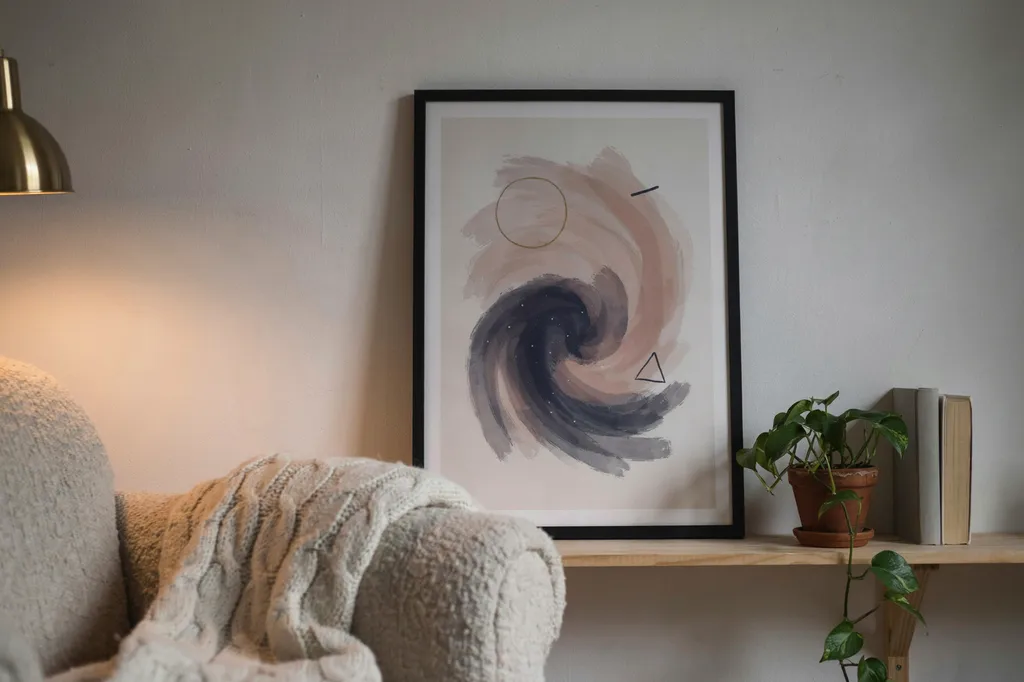

Celestial book art on matte paper, in sizes up to A1, which is large enough to hold a whole wall on its own. Hang the center at 48 inches and it will meet you at eye level every time you look up.
9. What does a reading nook cost to build?
Between $120 and $300 if you already own a chair, and roughly $300 to $800 if you do not. Buy in this order, because it is the order of how much each thing changes the feeling per dollar. Light first, at $35 to $90, because it is the single biggest shift and it works the same evening. Then the surface at $20 to $70. Then the rug at $40 to $150, which delivers the floor change and the sound absorption in one purchase. Then the third side, $30 to $120. Art last, at about $21 for a print plus a frame, because you want to live in the nook a while before you decide what you want to look at.

A relaxed fit tee for night readers, which is the only dress code the nook has. Sized for people who plan to be in a chair for four hours.
The real problem with reading nook inspiration
There is more reading nook imagery online than almost any other interior topic, and almost none of it tells you a single number. That is mass-produced indifference in its prettiest form: an endless scroll of identical mood boards, the same cream cushions, the same styled stack of books nobody has opened, sold to you as inspiration and useless the moment you stand in your own corner with a tape measure. A nook is not a mood, it is a set of dimensions and one honest decision about where the light goes. Funnily enough, the same principles came out of the gaming room work: warm light instead of overhead, small-space discipline, one object doing two jobs. If that is your other half, the cozy gaming setup guide and small gaming room ideas run the same playbook on a different chair.
Frequently asked questions
How to make a good reading nook?
Pick a corner so you already have two walls, then add the missing four cues. Build a third side with a bookcase, screen or curtain. Add a ceiling cue such as a low pendant or a shelf above the chair. Put a rug down for the floor change. Then add one warm lamp beside and slightly behind your shoulder.
What are the must-have reading nook items?
Five things, and only five. A seat 18 to 20 inches deep with the back at 105 to 110 degrees. One warm lamp with the shade bottom at 48 to 54 inches. A surface within 16 inches of your hand. A rug under the chair. Something forming the third side. Everything else is decoration you can add later.
What are some ideas for a cozy reading nook in a small space?
You need about 30 by 36 inches of floor, so look at closets, stair landings, dormer windows and the dead corner behind a door. Save floor space by clamping the lamp to a shelf instead of standing it, and by using a windowsill or a wall-mounted ledge as the surface. A small footprint makes the three-sided enclosure easier, not harder.
What are common mistakes in book nook design?
Four keep repeating. Using the room's overhead light instead of a lamp inside the nook. Choosing a lounge-depth chair, over 22 inches, so you fall asleep. Leaving out a surface, so the mug ends up on the floor. And skipping the ceiling cue, which is the one thing that stops a nook reading as furniture pushed against a wall.
What are some ideas for a cozy reading nook in a bedroom?
Put the chair in the corner furthest from the door and turn it away from the bed, so the nook is visually a separate room rather than an annex of the bedroom. Use the wardrobe or a tall shelf as the third side. Keep the lamp at 2700K so it does not fight your evening wind-down, and use a rug that stops short of the bed.
How much does a reading nook cost?
Roughly $120 to $300 if you already own a chair, and $300 to $800 if you are buying one. The lamp is $35 to $90, the surface $20 to $70, a 3 by 5 foot rug $40 to $150, and a screen, shelf or curtain for the third side $30 to $120. A print for the wall starts around $21 before a frame.
A corner that is somewhere else.
Art, totes and tees for people who read like it is a destination. Made on demand. Your Story, In Everyday Items.
Shop Book Lover Gifts →Made on demand. If a piece does not feel like it speaks your language, we will make it right.
Furnish the portal: browse the book lover gifts, the wall art for the one wall you can see, and the tote bags for the library run.

